Stop Making Million-Dollar Decisions From Survival Mode
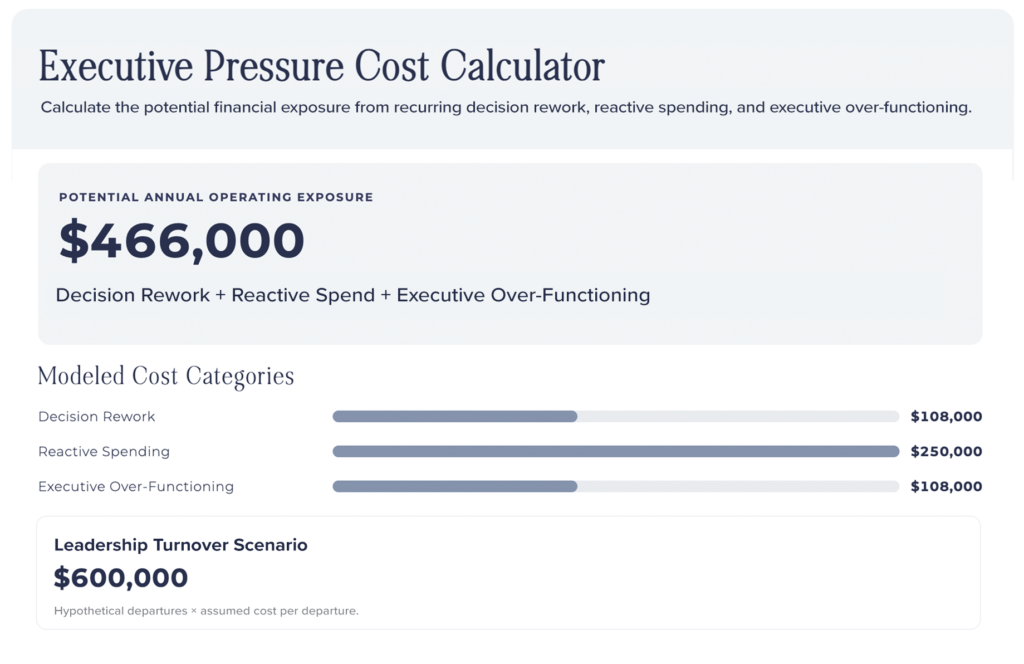
When revenue pressure rises, even experienced leaders can fall into conditioned responses that compromise decision quality, strain executive capacity, and waste capital. Calculate what executive pressure might be costing your organization.
You have run the analytics. You have shifted the strategy. You have restructured the team, replaced the agency, revised the forecast, and defended the pipeline in front of a board that keeps asking some version of the same question.
You know how to evaluate a business constraint. You understand the mechanics of demand, revenue, and growth.
But sustained pressure introduces another variable into the decisions you make.
It influences what feels urgent, which signals receive your attention, how you interpret resistance, and where you direct organizational resources. It can also reinforce leadership patterns that once helped you succeed but have become increasingly costly to maintain.
At this level of responsibility, the operating state you make decisions from has consequences far beyond your own experience.
The Cost of Sustained Executive Pressure Extends Beyond the Leader
Revenue pressure moves through an organization in ways that are not always visible on a dashboard. It can affect leadership continuity, slow consequential decisions, create unnecessary work, and redirect resources toward activities that relieve immediate discomfort without resolving the underlying business constraint. My work addresses three interconnected dimensions of executive effectiveness:
Risk Mitigation
Protecting the leadership capacity your business depends on.
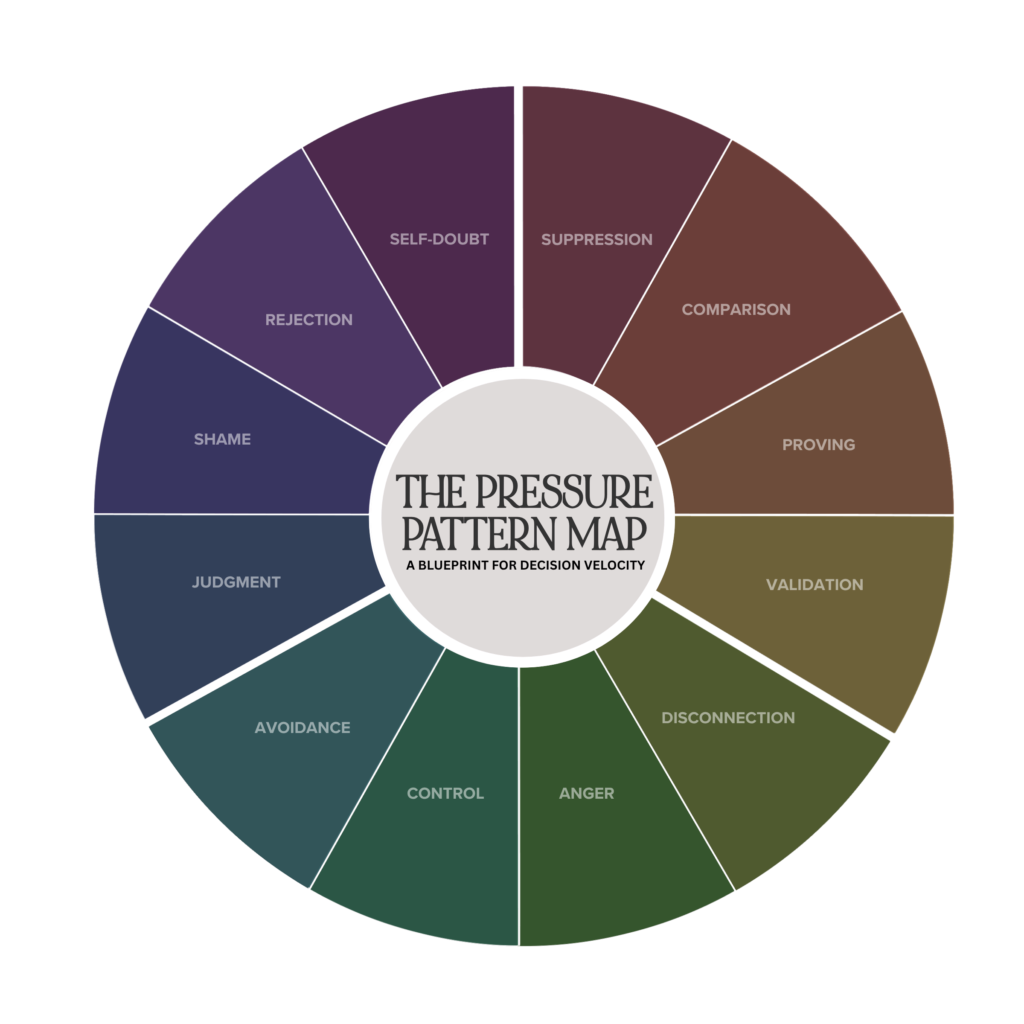
Sustained pressure can reinforce patterns of over-functioning, control, avoidance, and reactivity that contribute to executive exhaustion, strained relationships, and leadership instability. Recognizing these patterns creates opportunities to protect executive capacity, strengthen leadership continuity, and reduce avoidable organizational risk.
Decision Velocity
Making consequential decisions with greater clarity and precision.
High-stakes decisions require the ability to interpret complex information while navigating uncertainty, competing priorities, and stakeholder expectations. When survival responses begin shaping perception, leaders may delay necessary action, force premature pivots, or make decisions designed to relieve immediate pressure.
Decision velocity improves when leaders can distinguish genuine business risk from conditioned threat responses and act from a clearer understanding of what the situation requires.
Resource Optimization
Directing time, talent, technology, and capital toward what matters.
Reactive decisions have downstream costs.
Repeated strategic pivots, prolonged decision cycles, unnecessary escalations, and executive over-functioning can consume resources that would otherwise support growth.
By recognizing where pressure is influencing strategic choices, leaders can reduce avoidable friction and allocate organizational resources with greater intention.
Acknowledge the Pattern. Evolve Your Decision-Making.
Every executive brings conditioned patterns into the decisions they make. Many of these patterns developed through years of navigating responsibility, uncertainty, competition, and the demands of high performance. Explore the pattern that’s shaping your decisions and learn how to develop a more conscious relationship with it.
For CROs, CMOs, VPs of Sales & Marketing, and senior GTM leaders who are ready to stop letting survival mode become their strategy. This advisory work supports the individual leader, the demand system, and the executive teams responsible for delivering growth.
B2B Revenue Leaders
Decision Velocity Advisory
Private executive advisory for senior revenue leaders navigating high-stakes decisions, sustained growth pressure, and the internal patterns affecting their leadership capacity.
Senior-level strategic counsel for B2B leaders who need a clearer understanding of their demand system before committing additional budget, people, or execution resources.
A private half-day workshop for up to six executives navigating missed targets, cross-functional friction, decision delays, and the tendency to over-function under pressure.
Bridging Enterprise Revenue Architecture and Somatic Intelligence
For more than twenty years, I have worked inside the complex realities of B2B demand generation, marketing strategy, and revenue growth.
I understand the pressure of quarterly targets, the tension between Sales and Marketing, the scrutiny surrounding pipeline performance, and the strategic decisions that determine where organizations invest their time, people, technology, and capital.
That experience informs how I listen.
As a Decision Architect, I recognize patterns across the business environment and an executive’s operating state. I help leaders understand where commercial constraints require strategic intervention and where conditioned pressure responses may be distorting their interpretation of those constraints.
My work brings enterprise revenue fluency, somatic intelligence, and strategic discernment together to support clearer decisions when the stakes are high.